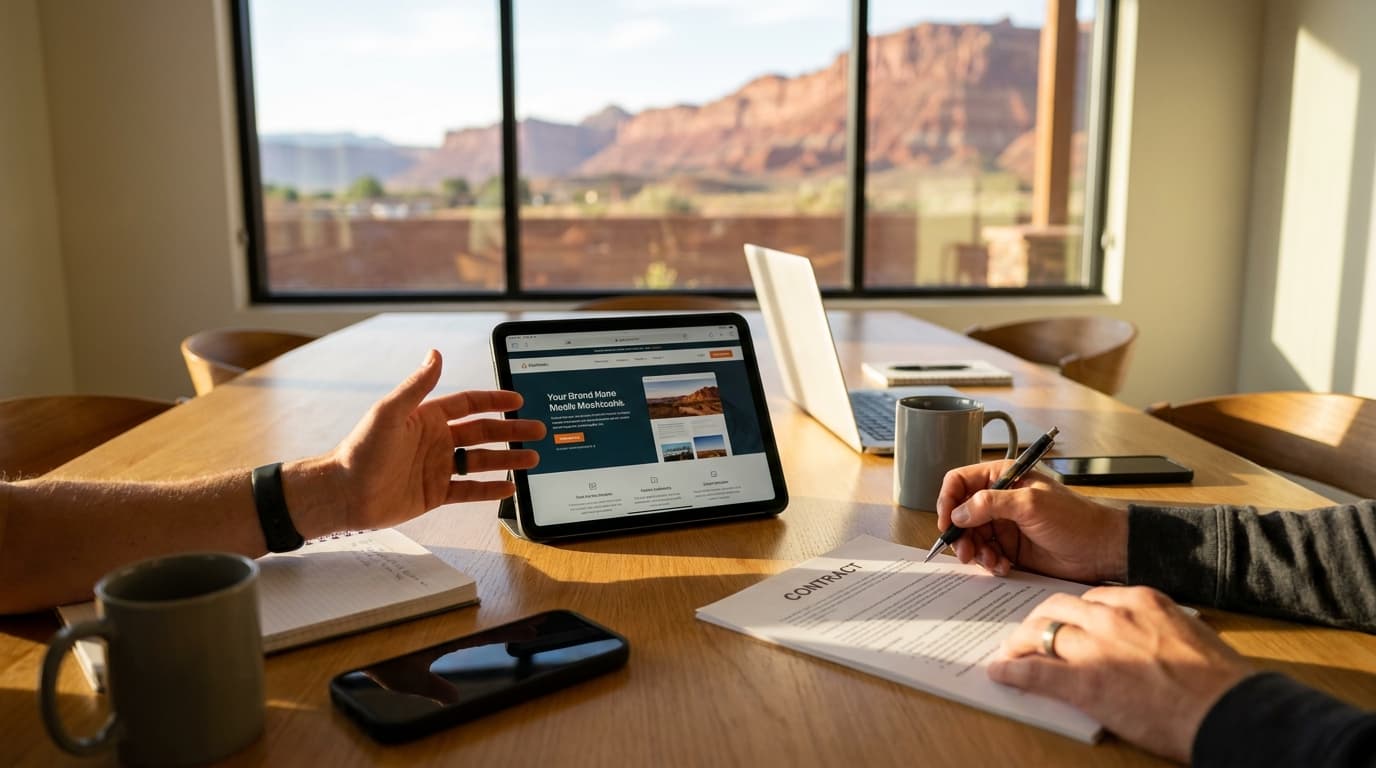
The Ultimate Guide to Hiring a Website Designer in Southern Utah (2025)
Introduction: Navigating the Digital Landscape of Southern Utah
Choosing the right website designer is one of the most critical decisions a business owner can make in today's digital-first world. Your website isn't just an online brochure; it's your 24/7 digital storefront, your primary marketing tool, and often the first impression potential customers have of your brand.
As Southern Utah's digital landscape evolves, with bustling tech corridors in St. George and a growing number of innovative businesses across Washington and Iron counties, the demand for high-quality, effective web design has never been greater. But with so many options—freelancers, agencies, and developers—how do you ensure you're making an informed choice that truly aligns with your business objectives?
This ultimate guide is designed specifically for Southern Utah business owners like you. We'll demystify the hiring process, highlight what to look for (and what to avoid), and provide practical, actionable advice to help you secure a web design partner who can transform your online presence. From understanding your needs to negotiating contracts and ensuring ongoing support, we've got you covered.
Pro Tip: Your website is an investment, not an expense. A well-designed, functional site can dramatically improve lead generation, sales, and brand credibility.
Quick Checklist: Top 10 Things to Look For in a Website Designer
The best way to start your search for a website designer is with a clear understanding of essential qualities. This checklist provides a concise overview of what to prioritize in your selection process, ensuring you cover all critical aspects.
Strong Portfolio: Look for diverse, high-quality work that aligns with your aesthetic and industry.
Proven Experience: Ensure they have a track record of successful projects and client satisfaction.
Clear Communication: They should be responsive, transparent, and able to explain technical concepts simply.
Understanding of Your Business: A good designer takes the time to grasp your goals, audience, and industry.
Technical Proficiency: Competence in current web standards, SEO best practices, and responsive design.
Project Management Skills: Look for organized processes, clear timelines, and effective project execution.
Post-Launch Support: Offering maintenance, updates, and troubleshooting after your site goes live.
References & Testimonials: Positive reviews and direct client feedback are invaluable.
Transparent Pricing: Clear, detailed quotes with no hidden fees.
Local Market Knowledge (Bonus): Understanding the unique digital landscape and consumer behavior in Southern Utah.
Most importantly: A good website designer acts as a partner, not just a vendor, invested in your success.
Chapter 1: Understanding Your Website Needs Before You Hire
Before you even begin searching for a designer, the most crucial step is to gain absolute clarity on what you need your website to achieve. This foundational work will inform every decision you make, from budget to desired features.
Assess Your Business Goals
Why do you need a new website, or a website at all? Defining your primary objectives will guide the design and functionality. Are you aiming to:
Generate Leads: Primarily focused on capturing contact information from potential clients.
Drive Sales: An e-commerce platform designed for direct product sales.
Increase Brand Awareness: A professional online presence to establish credibility and visibility.
Provide Information/Support: A resource hub for existing customers or community members.
Showcase Portfolio/Work: Essential for artists, photographers, or service-based businesses.
Be specific. Instead of "get more customers," aim for "increase online lead submissions by 20% within six months."
Define Your Target Audience
Who are you trying to reach? Understanding your audience's demographics, psychographics, and online behavior is vital. A website targeting local St. George retirees will look and function very differently from one targeting Cedar City university students. Consider:
Age, gender, location
Interests, pain points, aspirations
How they currently find information or purchase products/services
What devices they primarily use (mobile vs. desktop)
Determine Required Features and Functionality
Once you know your goals and audience, you can brainstorm the features your website will need. Don't worry about technical terms; describe what you want the site to do.
Basic informational pages: About Us, Services, Contact
E-commerce capabilities: Shopping cart, payment gateway, product catalogs
Contact forms: Customizable forms for inquiries, quote requests
Booking system: For appointments, reservations (e.g., a tour operator near Zion)
Blog/News section: For content marketing and SEO
Portfolio/Gallery: To display work samples
Customer login/portal: For personalized experiences
Integration with other tools: CRM, email marketing, social media
[Suggested Image: A whiteboard with various website features brainstormed and connected with lines]
Set a Realistic Budget
Your budget will significantly influence your choices. Website design costs vary widely based on complexity, features, and the designer's experience. Be honest about what you can afford, but also understand that a high-quality website is an investment that yields returns.
Note: A good portion of your budget should also be allocated for ongoing maintenance and potential marketing efforts after launch.
Southern Utah Business Considerations
Operating in Southern Utah brings unique opportunities and challenges. Your website should reflect this local nuance:
Tourism Focus: Many businesses in St. George, Springdale, and Hurricane cater to tourists. Your site might need excellent photography, clear directions, and online booking.
Local SEO: Optimizing for terms like "website designer St. George" or "auto repair Cedar City" is crucial for local visibility.
Community Engagement: Opportunities for local partnerships or showcasing community involvement can resonate well with the Southern Utah demographic.
Growth: The rapid growth of areas like Washington County means your site needs to be scalable.
Chapter 2: Website Designer vs. Developer vs. Agency
Understanding the distinctions between a freelance website designer, a web developer, and a full-service agency is crucial for choosing the right partner for your project. Each has its strengths, weaknesses, and ideal use cases.
Clear Definitions of Each
Website Designer: Focuses on the visual appeal and user experience (UX) of a website. They determine the layout, color schemes, typography, and overall aesthetic. They often use tools like Figma, Sketch, or Photoshop to create mockups and prototypes.
Web Developer: Builds the functional aspects of a website. This includes front-end development (what users interact with, using HTML, CSS, JavaScript) and back-end development (server-side logic, databases, APIs, using languages like Python, PHP, Ruby). They make the design come to life and implement all the features.
Web Design Agency: A team of professionals that typically offers a comprehensive suite of services, including design, development, content creation, SEO, marketing, and ongoing support. They have specialized roles collaborating on a project.
Comparison Table: Who to Hire When
Below is a quick reference to help you decide which type of professional best fits your needs:
Characteristic Freelance Website Designer Freelance Web Developer Full-Service Web Agency Focus Visuals, UX/UI, Aesthetics Functionality, Code, Databases Full Scope: Design, Dev, Marketing, Strategy Best For Simple informational sites, re-branding, design-heavy projects Complex features, custom functionality, site speed optimization Comprehensive projects, ongoing support, branding & marketing Cost Range Mid-Low Mid-High High Communication Direct, 1-on-1 Direct, 1-on-1 (technical) Project manager, multiple points of contact Speed Can be fast for specific tasks Can be fast for specific tasks Varies, but robust processes Scalability Limited to one person's capacity Limited to one person's capacity Highly scalable, team resources Post-Launch Often limited or extra cost Often limited or extra cost Comprehensive packages available
When to Hire Which Type
Hire a Freelance Website Designer if: You need a visually stunning site with standard functionality, you have a solid content plan, or you're on a tighter budget with clear design needs. Often uses platforms like WordPress with page builders.
Hire a Freelance Web Developer if: Your project requires custom coding, unique interactions, complex integrations, or advanced database management. You might hire a designer first, then a developer to build it.
Hire a Full-Service Web Design Agency if: You need a complete solution from strategy and branding to design, development, SEO, and ongoing marketing. You appreciate a single point of contact for multiple services and have a larger budget.
What's Common in the Southern Utah Market
In Southern Utah, you'll find a healthy mix of all three. Many local businesses start with freelance designers or small agencies for their value and personal touch. As businesses grow, they often scale up to larger local agencies or freelancers who specialize in more complex development. The St. George tech sector has also seen an increase in specialized developers capable of handling intricate web applications.
Chapter 3: Essential Qualifications to Look For
When evaluating potential website designers, going beyond the glossy portfolio is essential. You need to assess a range of qualifications that speak to their capability, professionalism, and suitability as your partner.
Portfolio Quality: Beyond Just Pretty Pictures
A portfolio is more than just a gallery of past projects; it's a testament to their skill and style. Look for:
Relevance: Do they have experience in your industry or with similar project scopes?
Variety of Styles: Can they adapt their style to different brands, or do all their sites look similar?
User Experience (UX): Are the sites easy to navigate? Is the information clear and accessible?
Mobile Responsiveness: Does the site look and function well on various devices (phones, tablets, desktops)? This is non-negotiable in 2025.
Case Studies: Do they explain their process, the client's goals, and the results achieved? Check out our portfolio for examples.
Actionable Step: Don't just browse. Click through several live sites from their portfolio. Test functionality, check load times, and assess the overall user journey.
Local Market Experience: Understanding Southern Utah
While not strictly mandatory, a designer with local Southern Utah experience can offer significant advantages:
Understanding of Local Customers: They might intuitively grasp the regional demographic, local search trends, and community values in St. George, Cedar City, or Hurricane.
Local SEO Savvy: They understand the importance of optimizing for local keywords and Google My Business.
Networking: They may have connections to local photographers, content writers, or other valuable partners.
Accessibility: Easier to schedule in-person meetings, which some clients prefer.
Technical Skills Needed: The Backbone of Your Site
Even if you're not a tech expert, ensure your designer has a grasp of fundamental technical skills:
HTML5, CSS3, JavaScript: The building blocks of any modern website.
Content Management Systems (CMS): Expertise in platforms like WordPress (most common), Shopify, Wix, or Squarespace, depending on your needs.
Responsive Design Principles: Ensuring a seamless experience across all devices.
Basic SEO Principles: Knowledge of how to structure a site for search engine visibility.
Security Best Practices: Understanding of SSL certificates, basic hardening, and regular backups.
Website Performance Optimization: Awareness of factors affecting site speed and how to improve them.
AI Integration: Modern websites can benefit from AI-powered features like chatbots and automation.
Communication Style: Your Partner in the Process
A designer's communication style is as important as their technical prowess. Look for someone who is:
Responsive: Do they reply to emails and calls promptly?
Clear and Concise: Can they explain complex technical concepts in layman's terms?
Proactive: Do they offer suggestions and anticipate potential issues?
Good Listener: Do they genuinely listen to your needs and feedback?
Structured: Do they use project management tools or established communication channels?
[Suggested Image: Two people conversing amiably over a laptop, showing good communication]
Project Management Approach: Keeping Things on Track
How will they manage your project? A well-defined process is a sign of professionalism:
Clear Milestones: Are there defined phases for discovery, design, development, and launch?
Timelines: Do they provide realistic estimates for project completion?
Feedback Loops: How will they incorporate your feedback at various stages?
Documentation: Will you receive documentation for your website (e.g., login details, CMS tutorials)?
Ongoing Support Offerings: Post-Launch Peace of Mind
Your website isn't a 'set it and forget it' asset. Ask about ongoing support:
Maintenance Plans: Do they offer regular updates, backups, and security checks?
Troubleshooting: What happens if something breaks after launch?
Growth Support: Can they help you with future updates, new features, or marketing initiatives?
Chapter 4: Red Flags to Avoid When Hiring a Web Designer
While many excellent website designers operate in Southern Utah, it's equally important to recognize potential pitfalls. Being aware of red flags can save you time, money, and considerable frustration.
Warning Signs of Bad Designers or Agencies
The best way to protect your investment is to pay attention to these common indicators that a designer might not be the right fit:
Lack of a Portfolio: If they can't show you their past work, it's a huge red flag.
Unrealistic Promises: Beware of designers guaranteeing 'first page Google rankings overnight' or exceptionally fast delivery for complex projects.
Poor Communication: Slow response times, vague answers, or difficulty understanding your core needs are all warning signs.
No Contract or Vague Agreements: A professional will always provide a detailed contract outlining scope, timelines, and costs.
Demands 100% Upfront Payment: While an initial deposit is typical, paying the entire project cost upfront is risky.
Negative Reviews or No References: Check online reviews (Google, Yelp, Facebook) and always ask for references you can contact.
One-Size-Fits-All Approach: If they only offer templates without customization or don't inquire about your unique business, they might not deliver a tailored solution.
Common Scams in the Web Design Industry
Unfortunately, like any industry, web design has its share of scammers. Be wary of:
"Free Website" Offers: These often come with hidden costs, terrible quality, or lock you into expensive monthly fees with no ownership of the site.
SEO Guarantees: No legitimate SEO professional can guarantee specific search engine rankings.
Phishing from Unknown Sources: Be cautious of unsolicited emails offering web design services that look too good to be true.
Holding Your Website Hostage: Some unscrupulous designers might refuse to give you access to your website files or hosting after payment disputes. Ensure your contract specifies ownership of all assets.
Questions That Should Concern You
"Can I just have a website for $X?" (without discussing your needs)
"I'll build it, and then you send me money." (lack of proper payment structure)
"Don't worry about the contract; we'll keep it simple."
"Just trust me; I know what's best for your business without your input."
"I don't need access to your old site or hosting." (can complicate migration)
Why Cheap Isn't Always Better
It's tempting to opt for the lowest bid, especially for small businesses in competitive markets like Southern Utah. However, a dirt-cheap website often comes at a higher long-term cost:
Poor Quality/Functionality: A low price often means corners are cut, leading to a slow, buggy, or aesthetically unappealing site.
Lack of SEO: Your cheap site might look nice but be invisible to search engines, defeating the purpose.
No Support: You'll be left to fend for yourself when issues arise.
Security Vulnerabilities: Poorly coded sites are more susceptible to hacking.
Scalability Issues: It often costs more to fix and rebuild a bad website than to invest in quality from the start.
The Bottom Line: While budget is always a factor, prioritize value and quality over simply finding the cheapest option. A well-executed web design project pays for itself through improved conversions, credibility, and customer engagement.
Learn more about our approach to web design and how we prioritize your success. Or call (435) 266-0441 for a free 15-minute consultation.