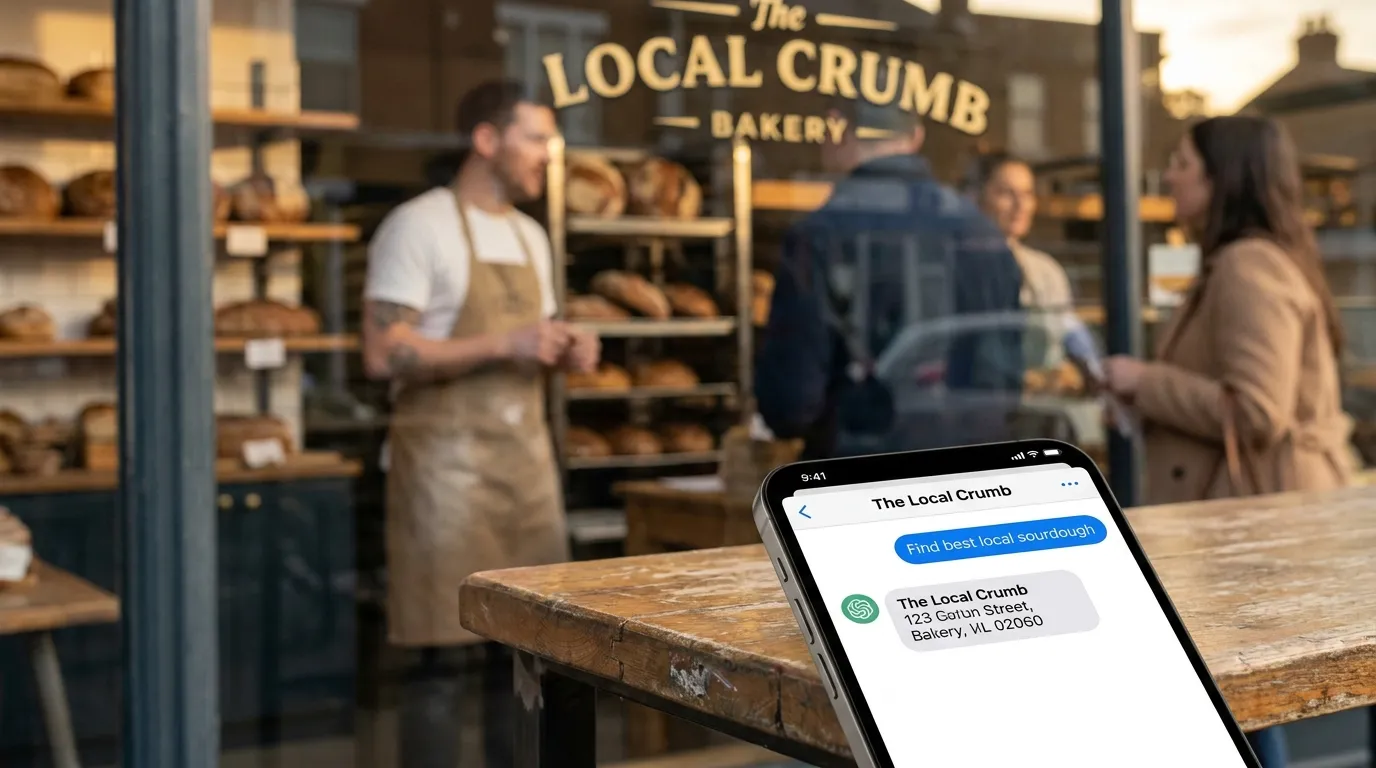
How to Get Your Small Business Found in ChatGPT & AI
If you've noticed fewer clicks coming from Google lately, you're not imagining it. The way people search is shifting dramatically. Instead of typing keywords and scrolling through ten blue links, more users are asking ChatGPT, Perplexity, Claude, and Google's AI Overviews for direct answers. For small business owners, this raises an urgent question: how do you get your business mentioned when an AI answers a question about your industry?
The good news? AI search optimization isn't reserved for Fortune 500 companies with massive marketing budgets. In fact, small businesses often have an advantage because they can move quickly, create niche content, and build the kind of authentic authority that AI models trust.
In this guide, we'll break down exactly how AI search engines decide which businesses to mention, and the practical steps you can take this month to start showing up in those AI-generated answers.
Understanding How AI Search Engines Find Businesses
Before you can optimize for AI search, you need to understand how these systems actually work. Unlike traditional search engines that crawl and rank pages, large language models (LLMs) like ChatGPT generate answers by synthesizing information from their training data and, increasingly, from real-time web searches.
There are essentially two ways your business can show up in an AI answer:
Training data citations: The AI learned about your business from content published before its knowledge cutoff date.
Real-time retrieval: Tools like ChatGPT Search, Perplexity, and Google's AI Overviews actively pull live information from the web to answer queries.
This new discipline is often called Generative Engine Optimization (GEO) or Answer Engine Optimization (AEO). While it builds on traditional SEO principles, it requires a different mindset focused on being the source AI tools quote rather than just ranking for keywords.
Why Traditional SEO Isn't Enough Anymore
Traditional SEO focuses on getting users to click your link. AI search optimization focuses on getting your business mentioned in the answer itself, even if the user never visits your website. This shift means you need to think less about driving traffic to your site and more about establishing your brand as a trusted, citable authority across the web.
Recent studies show that AI Overviews can reduce organic click-through rates by up to 34% for informational queries. Visibility within the AI answer is becoming as valuable as a top-ranked link.
Build a Foundation AI Models Can Trust
AI systems prioritize sources that demonstrate expertise, authority, and trustworthiness, the same E-E-A-T principles Google uses. For a small business, this starts with making sure your basic digital footprint is solid and consistent.
Optimize Your Google Business Profile
Your Google Business Profile is one of the most heavily weighted data sources for local AI queries. When someone asks ChatGPT, "What's the best web design agency in St. George, Utah?" the AI often pulls from structured business data that originated in profiles like this.
Complete every field, including services, hours, attributes, and FAQs
Upload high-quality photos with descriptive filenames
Encourage detailed reviews that mention specific services
Post regular updates and offers
Respond to every review, positive or negative
Ensure NAP Consistency Across the Web
Your Name, Address, and Phone number should be identical across every directory, social profile, and citation source. AI models cross-reference this information to verify legitimacy. Tools like Yext, BrightLocal, or even a manual audit can help you clean up inconsistencies.
Create Content That AI Models Want to Cite
Here's where many small businesses go wrong: they create content designed to rank, not content designed to answer. AI systems are looking for clear, direct, well-structured information they can confidently extract and present to users.
Write in a Question-and-Answer Format
Structure your content the way people actually ask AI assistants questions. Use natural, conversational headings like:
"What does a custom website cost in 2025?"
"How long does SEO take to show results?"
"Why is my small business not showing up on Google?"
Then provide a concise, direct answer in the first two or three sentences, followed by deeper context. This format mirrors how AI models extract featured snippet-style answers.
Use Schema Markup to Speak AI's Language
Structured data helps AI models understand exactly what your content is about. At minimum, implement:
LocalBusinessschema for your homepage and contact pageFAQPageschema for question-based contentArticleschema for blog postsServiceschema for individual offeringsReviewandAggregateRatingschema where applicable
Demonstrate Real Expertise
AI models are getting better at detecting generic, AI-generated fluff. To stand out, publish content that includes:
First-hand experience: Case studies, client results, and behind-the-scenes insights
Original data: Surveys, benchmarks, or analysis only your business could produce
Specific local knowledge: Information tied to your city, industry, or niche
Author bios: Clearly identify who wrote the content and their credentials
Get Mentioned on Sources AI Already Trusts
One of the biggest factors in AI citations is third-party validation. If multiple authoritative sites mention your business, AI models gain confidence that you're a legitimate, relevant answer.
Target High-Authority Directories and Publications
Focus on getting listed and mentioned in places AI tools frequently pull from:
Industry directories: Clutch, G2, Capterra, and niche-specific platforms
Local publications: Chamber of Commerce sites, regional business journals, and local news outlets
Reddit and forums: AI models, especially ChatGPT and Perplexity, heavily reference Reddit threads
Wikipedia and Wikidata: If your business meets notability standards, these are gold
YouTube: Video content with detailed descriptions and transcripts is increasingly cited
Encourage Authentic Reviews and Mentions
Reviews aren't just for customers, they're training data. AI systems read reviews on Google, Yelp, Facebook, and industry-specific sites to understand what your business does well. Encourage customers to mention specific services, locations, and outcomes in their reviews, not just "great service."
A review that says "B-Squared Technologies redesigned our St. George dental practice website and tripled our new patient inquiries" is exponentially more valuable to AI than "Great company!"
Technical Optimization for AI Crawlers
AI tools use specialized crawlers to gather information, and your site needs to welcome them. Many small business websites accidentally block these bots or make their content difficult to parse.
Allow AI Crawlers in Your robots.txt
Check your robots.txt file and make sure you're not blocking key AI user agents like GPTBot, PerplexityBot, ClaudeBot, and Google-Extended. Blocking them means zero chance of being cited.
User-agent: GPTBot
Allow: /

User-agent: PerplexityBot
Allow: /

User-agent: ClaudeBot
Allow: /
Prioritize Page Speed and Clean HTML
AI crawlers, like search engine crawlers, favor sites that load quickly and use semantic HTML. Avoid burying important content inside JavaScript that requires rendering. Use proper heading hierarchy, descriptive alt text, and clean URL structures.
Measure and Refine Your AI Visibility
You can't improve what you don't measure. Fortunately, tools are emerging to help small businesses track their visibility across AI platforms.
Test Your Brand in AI Tools Regularly
At least once a month, run a series of test queries in ChatGPT, Perplexity, Gemini, and Claude. Ask questions like:
"Who are the best [your service] providers in [your city]?"
"What companies offer [your specific service]?"
"Tell me about [your business name]."
Document the answers, note which competitors appear, and identify which sources the AI cites. This shows you exactly where to focus your outreach and content efforts.
Track AI Referral Traffic
In Google Analytics 4, watch for referrals from chatgpt.com, perplexity.ai, gemini.google.com, and similar domains. While the volume may still be small, the quality of these visitors tends to be high because they've already received a recommendation from a trusted AI source.
The Long Game: Authority Compounds
Getting your small business cited by ChatGPT and other AI tools isn't an overnight project. It's the result of consistently publishing helpful content, earning credible mentions, and maintaining a clean, well-structured digital presence. The businesses winning in AI search today started building their foundations months or years ago.
But here's the encouraging part: every piece of helpful content you publish, every quality review you earn, and every accurate citation you build adds up. AI models update constantly, and small businesses that take action now will compound their visibility well into the future.
If you're ready to position your small business for the AI search era but don't know where to start, B-Squared Technologies can help. We specialize in SEO, AI optimization, and web design strategies built specifically for small businesses in Southern Utah and beyond. Contact us today at (435) 266-0441 for a free AI visibility audit and discover exactly where your business stands and how to start showing up in the answers that matter.